Cryptocurrency offers financial freedom, innovation, and global access—but it also attracts scammers. Every year, billions of dollars are lost to crypto scams, rug pulls, phishing attacks, fake projects, and fraudulent platforms. Because crypto transactions are irreversible and decentralized, once funds are stolen, recovery is extremely difficult.
This guide explains how crypto scams work, how to identify rug pulls before they happen, and the best security practices to protect your assets. Whether you are a beginner or an experienced investor, understanding these risks is essential for staying safe in the crypto space.
What Are Cryptocurrency Scams?
Cryptocurrency scams are deceptive schemes designed to trick users into sending crypto, revealing private keys, or investing in fake or manipulated projects.
Unlike traditional financial fraud, crypto scams often:
-
Exploit lack of regulation
-
Use irreversible transactions
-
Target users directly through social media, messaging apps, and fake websites
Once crypto is sent, there is no chargeback, no customer service, and no central authority to reverse the transaction.
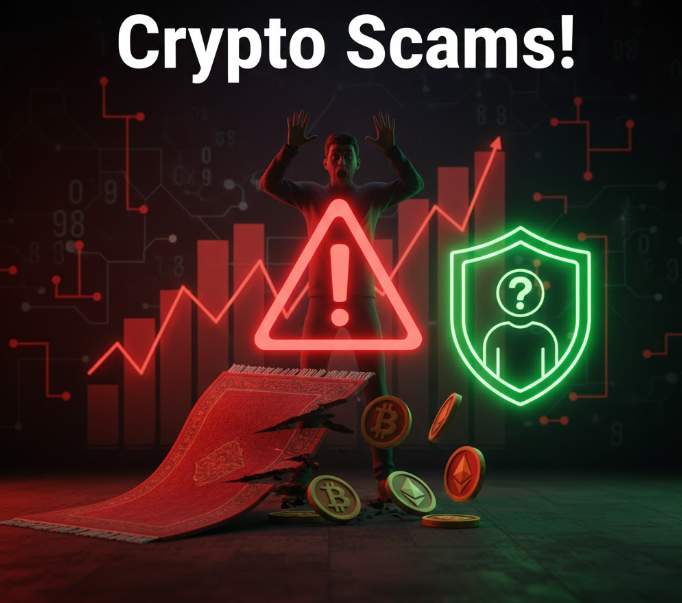
What Is a Rug Pull in Crypto?
A rug pull is a specific type of scam common in decentralized finance (DeFi) and new token launches.
In a rug pull:
-
Developers launch a new crypto token or project
-
They attract investors through marketing and hype
-
Liquidity is suddenly removed or tokens are dumped
-
The price collapses
-
Developers disappear with the funds
Rug pulls are especially common with:
-
New DeFi tokens
-
Meme coins
-
NFT projects
-
Low-liquidity trading pairs
Common Types of Cryptocurrency Scams
1. Phishing Scams
Phishing is one of the most widespread crypto threats.
How it works:
-
Fake websites or emails imitate real platforms
-
Users are asked to log in or connect wallets
-
Private keys or approvals are stolen
Common phishing methods:
-
Fake exchange login pages
-
Fake wallet updates
-
Malicious browser extensions
-
Social media DMs with fake links
2. Fake Crypto Giveaways
Scammers impersonate:
-
Celebrities
-
Influencers
-
Exchanges
-
Crypto companies
They promise to “send back double” what you send.
Reality:
No legitimate crypto giveaway requires you to send funds first.
3. Investment & Trading Scams
These scams promise:
-
Guaranteed profits
-
Fixed daily returns
-
“Risk-free” trading bots
Crypto markets are volatile. Guaranteed profits do not exist.
4. Rug Pull Tokens
Signs of rug pull tokens:
-
Anonymous developers
-
No real product
-
Locked liquidity that can be unlocked early
-
Sudden massive selling by insiders
5. Fake Wallets & Apps
Malicious apps pretend to be:
-
Wallets
-
Portfolio trackers
-
Mining apps
They steal private keys or seed phrases once entered.
6. Romance & Social Engineering Scams
Scammers build trust over time via:
-
Dating apps
-
Telegram groups
-
WhatsApp messages
They eventually introduce fake investment opportunities.
Why Crypto Scams Are So Effective
Crypto scams succeed because:
-
New users lack technical knowledge
-
Transactions are irreversible
-
Projects launch quickly with little oversight
-
Social media spreads hype rapidly
-
Fear of missing out (FOMO) clouds judgment
Scammers exploit urgency, greed, and trust.
How to Identify a Rug Pull Before It Happens
1. Check the Team Transparency
-
Are developers publicly known?
-
Do they have verifiable past projects?
-
Are profiles real and consistent?
Anonymous teams are not always scams—but they increase risk.
2. Review the Tokenomics
Warning signs:
-
Very high developer token allocation
-
No vesting schedule
-
Unlimited minting capability
-
No clear utility
If developers can dump large amounts anytime, risk is high.
3. Analyze Liquidity Locking
Healthy projects usually:
-
Lock liquidity for a fixed period
-
Use transparent locking mechanisms
Red flags:
-
Liquidity unlockable at any time
-
Single wallet controlling liquidity
4. Inspect Smart Contracts
Even non-developers can check:
-
Whether contracts are verified
-
Whether ownership can be changed
-
Whether trading can be paused
Hidden functions can allow developers to block selling or drain funds.
5. Watch Community Behavior
Suspicious communities often show:
-
Overhyped promises
-
Aggressive moderation
-
Deletion of critical questions
-
Pressure to “buy now”
Healthy communities welcome transparency and questions.
How to Avoid Cryptocurrency Scams (Best Practices)
1. Never Share Your Private Keys or Seed Phrase
No legitimate service will ever ask for them.
2. Verify URLs and Apps
-
Bookmark official websites
-
Avoid links from DMs
-
Double-check spelling
3. Use Hardware Wallets
Hardware wallets protect private keys offline, reducing phishing risk.
4. Use Separate Wallets
-
One wallet for long-term storage
-
One wallet for DeFi and experimental projects
This limits damage if a wallet is compromised.
5. Avoid “Too Good to Be True” Offers
If returns sound unrealistic, they usually are.
6. Research Before Investing
Always:
-
Read documentation
-
Understand the product
-
Verify smart contract audits (when available)
7. Limit Token Approvals
Regularly review and revoke unnecessary wallet permissions.
8. Use Strong Security Habits
-
Enable two-factor authentication
-
Use strong, unique passwords
-
Keep devices updated
What to Do If You’ve Been Scammed
If you suspect fraud:
-
Stop interacting immediately
-
Revoke wallet permissions
-
Move remaining funds to a secure wallet
-
Document transaction details
-
Report to exchanges (if applicable)
-
File reports with relevant authorities
Recovery is difficult, but quick action can limit damage.
Are Crypto Scams Illegal?
In most countries:
-
Crypto scams are illegal
-
Rug pulls may be prosecuted as fraud
-
Enforcement depends on jurisdiction
However, decentralized projects and anonymous teams make prosecution difficult.
The Role of Regulation in Preventing Scams
Governments are increasingly:
-
Enforcing KYC on exchanges
-
Requiring disclosures for token sales
-
Investigating fraudulent projects
While regulation may reduce scams, personal responsibility remains the first line of defense.
Frequently Asked Questions (FAQ)
Are all new crypto projects scams?
No, but new projects carry higher risk. Research is critical.
Can stolen crypto be recovered?
Usually no. Recovery depends on early intervention and exchange involvement.
Are audits a guarantee of safety?
No. Audits reduce risk but do not eliminate it.
Is DeFi more dangerous than centralized platforms?
DeFi removes intermediaries, increasing user responsibility and risk.
How do scammers target beginners?
Through social media hype, fake support messages, and urgency tactics.
Is it safer to store crypto on exchanges?
Exchanges are convenient but expose users to custodial risk. Long-term storage is safer in self-custody wallets.
Final Thoughts
Cryptocurrency empowers individuals—but with that power comes responsibility. Scams and rug pulls thrive where users rush, skip research, or rely on trust instead of verification.
By understanding how scams work, recognizing red flags early, and following strong security practices, you can dramatically reduce your risk and protect your assets.
In crypto, security is not optional—it is essential.