Blockchain technology has transformed how digital transactions are recorded and verified. However, as blockchain adoption grows worldwide, many networks struggle with slow speeds and high transaction fees. This challenge has led to the development of Layer-2 scaling solutions, one of the most important innovations in modern blockchain infrastructure.
In this in-depth guide, you’ll learn what Layer-2 scaling is, how it works, why it matters, and the major types of Layer-2 technologies powering today’s blockchain ecosystem.
Understanding the Blockchain Scalability Problem
Most popular blockchains were designed with security and decentralization as their core principles. While this design ensures trust and transparency, it also limits performance.
For example:
-
Bitcoin processes only a few transactions per second
-
Ethereum handles around 15–30 transactions per second
-
High demand leads to congestion and increased transaction fees
This problem is commonly explained using the Blockchain Trilemma, which states that a blockchain can only fully optimize two of the following three features at the same time:
-
Security
-
Decentralization
-
Scalability
Layer-1 blockchains focus heavily on security and decentralization, leaving scalability as a challenge. This is where Layer-2 scaling comes in.
What Is Layer-2 Scaling in Blockchain?
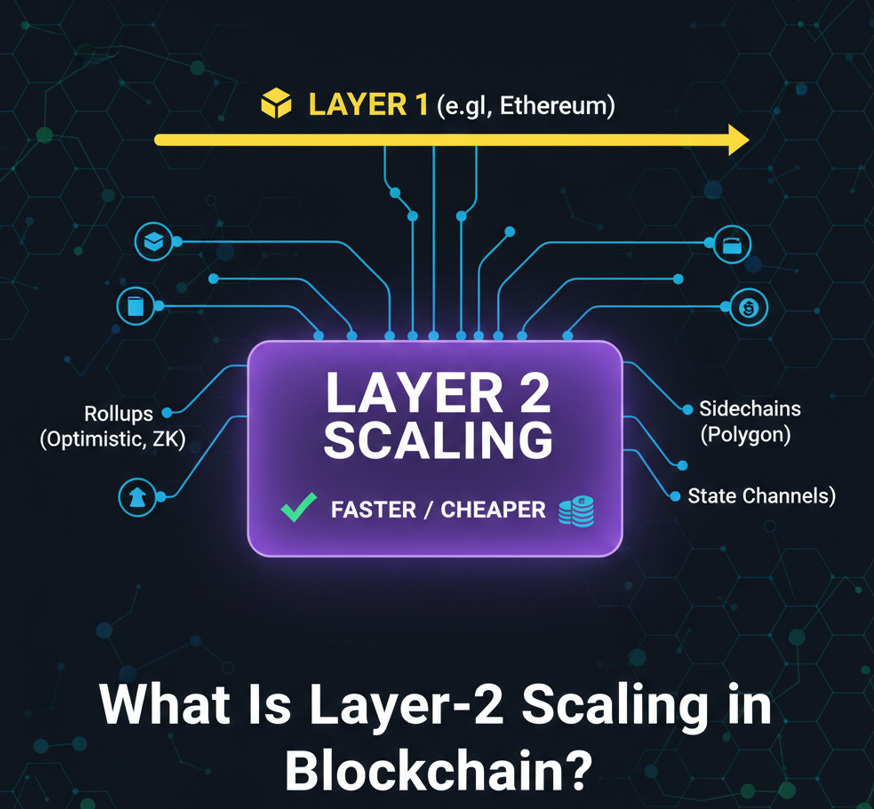
Layer-2 scaling refers to technologies built on top of an existing blockchain (Layer-1) that process transactions outside the main chain while still relying on it for security.
In simple terms:
-
Layer-1 is the base blockchain, such as Ethereum or Bitcoin
-
Layer-2 is an additional system that handles transactions more efficiently
Layer-2 solutions reduce congestion by moving most transaction activity off the main chain and then submitting summarized results back to it.
How Layer-2 Scaling Works
Instead of recording every transaction directly on the main blockchain, Layer-2 solutions follow a more efficient process:
-
Users submit transactions to a Layer-2 network
-
The Layer-2 network processes many transactions quickly
-
Transactions are bundled or verified off-chain
-
A compressed proof or summary is sent to the Layer-1 blockchain
The Layer-1 chain remains the final authority, ensuring trust and immutability.
This approach dramatically improves performance while maintaining blockchain security.
Why Layer-2 Scaling Is Important
Layer-2 scaling is essential for real-world blockchain adoption. Without it, blockchain networks would struggle to support global usage.
Key Benefits of Layer-2 Solutions
-
Lower transaction fees
-
Faster confirmation times
-
Reduced network congestion
-
Better user experience
-
Support for decentralized finance (DeFi), NFTs, and gaming
Layer-2 makes blockchain technology practical for everyday users, not just early adopters.
Major Types of Layer-2 Scaling Solutions
Several Layer-2 technologies exist, each designed for different use cases and performance goals.
1. Rollups
Rollups are currently the most widely used Layer-2 scaling solution, especially on Ethereum.
Rollups bundle thousands of transactions into a single transaction that is submitted to the main chain.
There are two main types of rollups:
Optimistic Rollups
Optimistic rollups assume transactions are valid by default. If someone detects fraud, they can submit a challenge during a defined dispute period.
Key features:
-
Transactions are processed off-chain
-
Fraud proofs are used for security
-
Compatible with existing Ethereum smart contracts
Advantages:
-
Lower gas fees
-
Strong security guarantees
-
Easy integration for developers
Limitations:
-
Withdrawal delays due to challenge periods
Examples include popular Ethereum scaling networks used by DeFi platforms.
Zero-Knowledge (ZK) Rollups
ZK rollups use advanced cryptography to prove transaction validity instantly without revealing transaction details.
Instead of fraud proofs, ZK rollups rely on mathematical proofs that confirm correctness before transactions are finalized.
Advantages:
-
Faster finality
-
No dispute periods
-
Extremely low fees
Challenges:
-
More complex technology
-
Higher development costs
ZK rollups are considered one of the most promising long-term scaling solutions.
2. State Channels
State channels allow participants to conduct transactions privately off-chain and only record the final result on the blockchain.
How state channels work:
-
Participants lock funds in a smart contract
-
Transactions occur off-chain
-
Final balances are settled on Layer-1
Advantages:
-
Instant transactions
-
Minimal fees
Limitations:
-
Only works for fixed participants
-
Not ideal for complex decentralized applications
A well-known example of state channels is Bitcoin’s Lightning Network.
3. Plasma Chains
Plasma chains are smaller child blockchains connected to a main blockchain.
They process transactions independently and periodically submit summaries to the main chain.
Advantages:
-
Reduced load on Layer-1
-
Improved scalability
Limitations:
-
Complex user experience
-
Limited smart contract flexibility
While less common today, Plasma played a significant role in the evolution of Layer-2 technologies.
4. Sidechains (Important Clarification)
Sidechains are often confused with Layer-2 solutions, but they are technically different.
Sidechains are separate blockchains connected to a main chain via a bridge. They have their own validators and consensus mechanisms.
Key difference:
-
Sidechains do not inherit Layer-1 security directly
Because of this, many experts do not consider sidechains true Layer-2 solutions, even though they offer scalability benefits.
Layer-2 vs Layer-1: Key Differences
| Feature | Layer-1 | Layer-2 |
|---|---|---|
| Purpose | Base blockchain | Scaling layer |
| Transaction Speed | Slower | Faster |
| Fees | Higher | Lower |
| Security | Native consensus | Inherits Layer-1 security |
| Examples | Ethereum, Bitcoin | Rollups, Channels |
Layer-2 does not replace Layer-1. Instead, it extends its capabilities.
Real-World Use Cases of Layer-2 Scaling
Layer-2 scaling enables many blockchain applications to function efficiently at scale.
Common use cases include:
-
Decentralized exchanges
-
NFT marketplaces
-
Blockchain gaming platforms
-
Micropayments
-
Cross-border payments
-
Web3 social applications
Without Layer-2 solutions, many of these applications would be too expensive or slow for everyday use.
Security of Layer-2 Solutions
Layer-2 networks are designed to maintain strong security by relying on Layer-1 blockchains.
Security features include:
-
On-chain data availability
-
Fraud proofs or cryptographic verification
-
User ability to exit to Layer-1
These mechanisms ensure users retain control of their funds even if a Layer-2 network fails.
Challenges Facing Layer-2 Scaling
Despite their advantages, Layer-2 solutions still face challenges:
-
Fragmented liquidity across networks
-
Complexity for new users
-
Bridge security risks
-
Interoperability limitations
Ongoing research and development aim to solve these issues and improve usability.
The Future of Layer-2 Scaling
Layer-2 scaling is becoming a foundational part of blockchain ecosystems.
Future developments include:
-
Improved cross-Layer-2 communication
-
Faster and safer asset bridges
-
Better developer tools
-
Wider institutional adoption
Many blockchain roadmaps, especially Ethereum’s, rely heavily on Layer-2 solutions for long-term scalability.
Final Thoughts
Layer-2 scaling is one of the most important breakthroughs in blockchain technology. It allows blockchains to grow without sacrificing decentralization or security.
As adoption increases, Layer-2 solutions will continue to shape the future of:
-
Decentralized finance
-
Digital ownership
-
Global payments
-
Web3 applications
Understanding Layer-2 scaling is essential for anyone interested in blockchain technology, crypto innovation, or the future of decentralized systems.