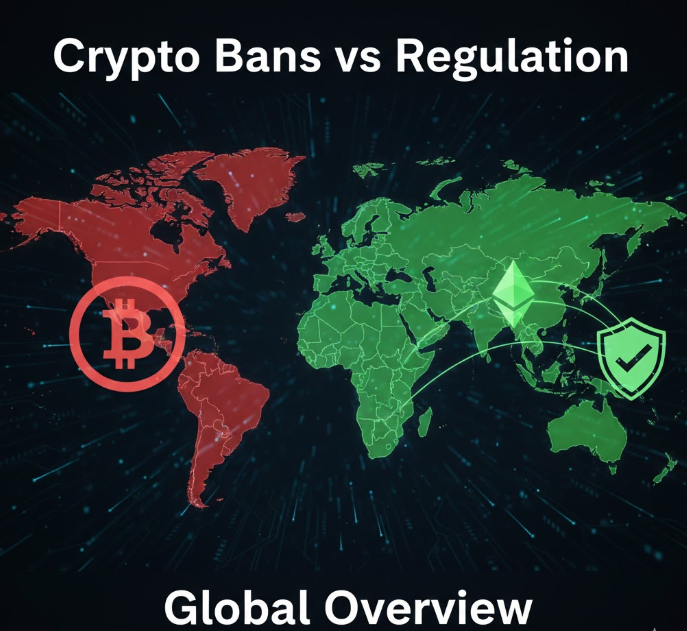
Cryptocurrencies have transformed the financial landscape, offering decentralized finance, borderless payments, and new investment opportunities. Yet, governments and regulatory authorities worldwide have taken diverse approaches, ranging from outright bans to carefully structured regulation. Understanding the difference between crypto bans and regulation is critical for investors, enterprises, and fintech professionals operating in a global market.
This guide provides a comprehensive global overview, exploring how bans and regulations affect adoption, security, compliance, and investment opportunities.
Understanding Crypto Bans
A crypto ban refers to a government prohibiting the use, trading, or mining of cryptocurrencies within its jurisdiction. Bans may be partial or total, targeting specific activities such as:
-
Trading on exchanges
-
Accepting crypto as payment
-
Mining operations
-
Initial Coin Offerings (ICOs)
Reasons Governments Impose Bans
-
Financial Stability Concerns
Cryptocurrencies can be highly volatile, potentially destabilizing local financial systems. -
Fraud and Scams
Bans aim to protect citizens from Ponzi schemes, pump-and-dump tactics, and other illicit activities. -
Tax Evasion Risks
Cryptocurrencies can make unreported transactions harder to trace. -
Money Laundering and Terror Financing
Bans may prevent funds from being transferred anonymously across borders. -
Energy Consumption
Some countries, particularly with crypto mining bans, cite excessive energy use as a reason.
Countries That Have Imposed Crypto Bans
Some notable examples include:
-
China – All crypto trading and mining activities banned since 2021
-
Algeria – Prohibits purchase, sale, and use of cryptocurrencies
-
Morocco – Crypto transactions are illegal
-
Nepal – All cryptocurrency transactions banned
-
Bangladesh – Trading and use of crypto are prohibited
In banned countries, residents face severe penalties, including fines and legal prosecution for using cryptocurrencies.
Understanding Crypto Regulation
Unlike bans, regulation permits crypto activity but under defined rules. Regulatory frameworks provide clarity, mitigate risk, and foster responsible adoption.
Common Regulatory Measures
-
Licensing Requirements
Exchanges, wallet providers, and custodians often require official licenses to operate. -
AML and KYC Compliance
Regulations enforce identity verification to prevent money laundering and terrorist financing. -
Taxation Rules
Investors may need to report crypto gains and losses, similar to other assets. -
Consumer Protection
Regulations may require exchanges to maintain reserves, implement cybersecurity measures, and disclose risks to users. -
Stablecoin Oversight
Some jurisdictions regulate stablecoins differently, due to their potential impact on the financial system.
Countries With Strong Crypto Regulation
-
United States – SEC and FinCEN regulate crypto as securities or financial instruments
-
European Union – MiCA (Markets in Crypto-Assets) framework standardizes crypto rules across member states
-
Singapore – MAS licenses and monitors crypto exchanges
-
Japan – Crypto exchanges are licensed and audited for compliance
-
Australia – Crypto businesses must comply with AML/KYC and tax regulations
Bans vs Regulation: Key Differences
| Feature | Crypto Ban | Crypto Regulation |
|---|---|---|
| Legal Status | Illegal | Legal under defined rules |
| Government Approach | Prohibition | Controlled, monitored activity |
| Investor Risk | High – penalties for violations | Moderate – risk limited to compliance |
| Adoption | Low | Higher adoption possible |
| Innovation | Stifled | Encourages fintech development |
| Taxation | Not applicable | Clear reporting requirements |
Implications for Investors and Businesses
For Investors
-
In banned countries: Accessing crypto may involve illegal workarounds, exposing investors to fines or asset seizure.
-
In regulated countries: Investors must comply with KYC/AML, report taxes, and follow legal frameworks.
For Enterprises
-
Banned countries: Exchanges and crypto startups cannot operate legally.
-
Regulated countries: Businesses can operate, innovate, and attract institutional clients while following compliance rules.
Global Considerations
-
Cross-border transactions can be affected if crypto is legal in one country but banned in another.
-
Investors need to monitor regulatory developments to avoid unintended violations.
-
Enterprises must maintain flexible compliance systems to navigate a patchwork of global laws.
Trends in Global Crypto Regulation
-
Shift from Bans to Regulation
Countries that previously banned crypto are gradually exploring regulatory frameworks (e.g., India, Turkey). -
Focus on Stablecoins and CBDCs
Regulators aim to control the rise of stablecoins and introduce central bank digital currencies (CBDCs) for stability. -
Enhanced Investor Protection
Frameworks increasingly focus on protecting retail investors from scams and volatility. -
AML/KYC Integration
Global standards, such as FATF travel rules, require cross-border AML compliance for crypto transfers. -
Tax Compliance
Governments are increasingly tracking crypto assets to ensure proper taxation.
Best Practices for Crypto Investors
-
Know Your Local Laws
Research whether crypto is banned or regulated in your jurisdiction. -
Use Licensed Exchanges
Even in countries with regulation, ensure your platforms comply with KYC/AML laws. -
Report Taxes Accurately
Track crypto transactions to comply with tax regulations. -
Diversify Custody
Use secure wallets and cold storage to protect assets. -
Stay Updated
Regulations change frequently; monitor government announcements and updates.
FAQ
Can I legally hold crypto in a country that bans it?
No. Holding or trading crypto in a banned country can lead to fines or legal action.
What is the difference between a ban and regulation?
A ban makes crypto illegal, while regulation allows it under defined rules.
Are all exchanges compliant with regulations?
Not necessarily. Only licensed exchanges meet regulatory standards.
Can I travel with crypto in a banned country?
Traveling is risky; local laws may consider possession illegal.
Will global crypto bans increase?
Bans are decreasing as countries shift toward regulation, though risk varies by region.
Conclusion
The global approach to cryptocurrency is a spectrum from strict bans to detailed regulation. Investors and enterprises must understand the legal environment in each jurisdiction to avoid risks and make informed decisions.
While bans limit access and innovation, regulation provides clarity, security, and opportunity, allowing the crypto ecosystem to grow responsibly. Monitoring global trends and staying compliant is key to protecting investments and ensuring long-term participation in the digital asset market.