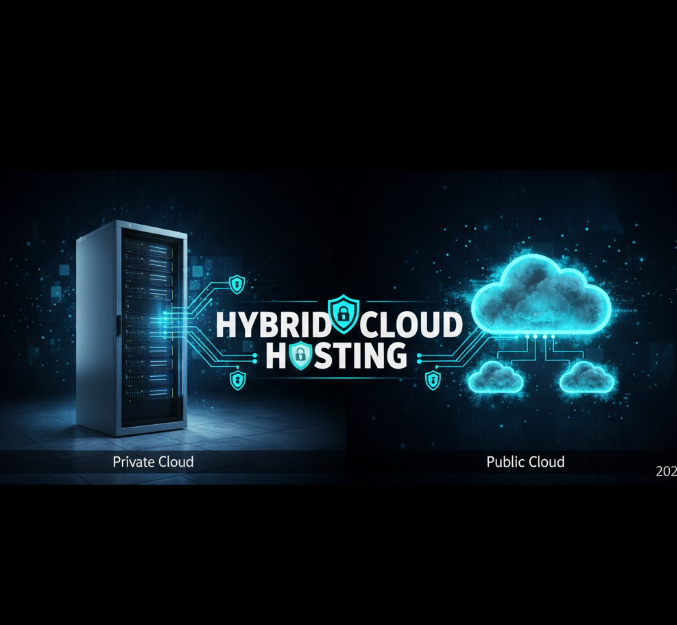
Cloud hosting is no longer a one-size-fits-all solution. As businesses grow, face stricter regulations, and manage more complex workloads, many discover that relying on a single cloud environment isn’t always practical. This is where hybrid cloud hosting comes in.
Hybrid cloud hosting combines the flexibility of public cloud services with the control of private infrastructure. Instead of choosing one or the other, organizations use both strategically. In 2026, this approach is becoming the norm for companies that want performance, security, and cost efficiency without sacrificing control.
This article explains what hybrid cloud hosting really is, how it works, its benefits and costs, and when it makes sense to use it.
What Is Hybrid Cloud Hosting?
Hybrid cloud hosting is an IT infrastructure model that connects a private environment (such as on-premises servers or a private cloud) with one or more public cloud platforms.
These environments are linked so data and applications can move between them when needed.
In simple terms:
-
Private side → sensitive data, critical systems, legacy applications
-
Public side → scalable workloads, backups, analytics, burst traffic
The key idea is integration, not separation. The systems are designed to work together as one environment.
How Hybrid Cloud Hosting Works
Hybrid cloud environments are connected through:
-
Secure network connections (VPNs or dedicated links)
-
Unified identity and access management
-
Centralized monitoring and management tools
A typical setup might look like this:
-
Core databases run on private infrastructure
-
Customer-facing applications run in the public cloud
-
Traffic spikes are handled by public cloud resources
-
Sensitive data stays under direct organizational control
This design allows businesses to place workloads where they make the most sense.
Why Businesses Choose Hybrid Cloud Hosting
Hybrid cloud is rarely chosen for hype or trends. It’s adopted to solve practical, real-world problems.
1. Better Control Over Sensitive Data
Not all data belongs in a public cloud. Financial records, health data, and proprietary systems often require tighter control.
Hybrid cloud allows organizations to:
-
Keep sensitive data on private infrastructure
-
Use public cloud services without exposing regulated assets
-
Meet data residency and compliance requirements
This is especially important for industries with strict regulations.
2. Cost Optimization
Public cloud resources are flexible but not always cheap when used continuously.
Hybrid cloud helps control costs by:
-
Running steady workloads on private infrastructure
-
Using public cloud only when demand increases
-
Avoiding overpaying for always-on cloud resources
Instead of paying for maximum capacity year-round, businesses pay for scalability only when they need it.
3. Scalability Without Overbuilding
Traditional infrastructure must be sized for peak demand, which often means unused capacity most of the time.
With hybrid cloud:
-
Private systems handle normal operations
-
Public cloud resources scale during traffic spikes
-
Systems return to normal once demand drops
This is commonly called cloud bursting.
4. Improved Business Continuity and Resilience
Hybrid cloud improves reliability by spreading workloads across environments.
Benefits include:
-
Disaster recovery in the public cloud
-
Reduced downtime during hardware failures
-
Backup systems outside the primary data center
If one environment goes down, another can take over critical functions.
5. Flexibility for Legacy and Modern Applications
Many organizations still rely on older applications that:
-
Cannot be easily moved to the cloud
-
Require specific hardware or configurations
Hybrid cloud allows:
-
Legacy systems to remain on private infrastructure
-
New applications to be built using modern cloud services
-
Gradual modernization without disruption
This makes hybrid cloud a bridge between old and new technologies.
Real Costs of Hybrid Cloud Hosting
Hybrid cloud hosting is not automatically cheaper or more expensive it depends on how it’s designed and managed.
Cost Components to Consider
-
Private infrastructure hardware and maintenance
-
Public cloud usage (compute, storage, networking)
-
Networking and data transfer costs
-
Security and monitoring tools
-
IT staff or managed service costs
While initial setup can be more complex, long-term savings often come from efficient workload placement.
Operational Complexity: The Trade-Off
Hybrid cloud offers flexibility, but it also introduces complexity.
Challenges include:
-
Managing multiple environments
-
Ensuring consistent security policies
-
Monitoring performance across systems
-
Coordinating updates and backups
This is why many organizations invest in:
-
Centralized management platforms
-
Automation tools
-
Skilled IT teams or managed service providers
Hybrid cloud works best when properly planned not improvised.
Common Hybrid Cloud Use Cases
Enterprise Applications
Large organizations often use hybrid cloud to balance compliance, performance, and scalability.
E-Commerce Platforms
Private systems handle transactions and customer data, while public cloud scales during sales events.
Financial Services
Sensitive data stays private, while analytics and reporting use public cloud power.
Healthcare Systems
Patient records remain private; public cloud supports applications and data analysis.
Software Development & Testing
Development environments run in the public cloud, while production systems remain private.
Hybrid Cloud vs Public Cloud vs Private Cloud
Hybrid cloud isn’t a replacement it’s a combination.
-
Public cloud → maximum flexibility, shared infrastructure
-
Private cloud → maximum control, higher fixed costs
-
Hybrid cloud → balanced approach for complex needs
The right choice depends on business goals, risk tolerance, and workload characteristics.
Is Hybrid Cloud the Right Choice for Everyone?
No—and that’s okay.
Hybrid cloud is best suited for:
-
Medium to large organizations
-
Businesses with compliance requirements
-
Companies with variable workloads
-
Teams with IT expertise or managed support
Smaller projects may find public cloud simpler and more cost-effective.
The Future of Hybrid Cloud Hosting
In 2026 and beyond, hybrid cloud is evolving with:
-
Better automation
-
Smarter workload orchestration
-
Tighter security integration
-
AI-driven monitoring and optimization
Rather than choosing between cloud and on-premises, organizations are choosing where each workload belongs.
Final Thoughts
Hybrid cloud hosting isn’t about chasing trends it’s about practical balance.
It allows organizations to:
-
Protect sensitive data
-
Control costs
-
Scale when needed
-
Modernize at their own pace
When designed thoughtfully, hybrid cloud becomes a powerful foundation for long-term growth.