
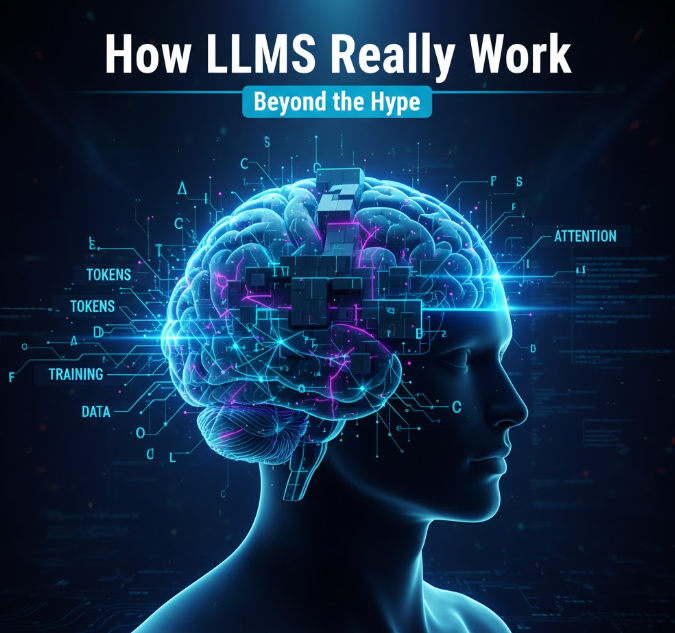
Large Language Models (LLMs) like ChatGPT, Gemini, and Claude are often described as “AI that understands language.” But behind the headlines and marketing buzz, these systems operate on very concrete mathematical and engineering principles.
This article breaks down how LLMs actually work, what they can and cannot do, and why they sometimes sound intelligent even when they’re not truly “thinking.”
What Is a Large Language Model (LLM)?
A Large Language Model is a type of artificial intelligence trained to predict the next word (or token) in a sequence based on massive amounts of text data.
At their core, LLMs do one main task:
Predict the most likely next token given everything that came before it.
They do not:
-
Think like humans
-
Understand meaning the way people do
-
Have beliefs, intentions, or awareness
Yet, because language itself carries structure and logic, LLMs can appear remarkably intelligent.
The Foundation: Tokens, Not Words
LLMs don’t read full words or sentences the way humans do.
Instead, text is broken into tokens, which can be:
-
Whole words
-
Parts of words
-
Punctuation
-
Symbols
Example:
Might be split into:
Every token is converted into a number, which the model processes mathematically.
Training Data: Where LLM Knowledge Comes From
LLMs are trained on very large datasets, often including:
-
Public websites
-
Books
-
Articles
-
Code repositories
-
Educational materials
-
Forums and Q&A sites
Important:
-
Models do not browse the internet in real time during training
-
They do not remember individual documents
-
They learn patterns, not facts stored like a database
Training teaches the model:
-
Grammar
-
Style
-
Common reasoning patterns
-
Relationships between concepts
The Core Technology: Neural Networks & Transformers
Neural Networks (Simplified)
A neural network is a layered system of mathematical functions that:
-
Takes inputs (tokens)
-
Applies weighted calculations
-
Produces probabilities for outputs
LLMs contain billions or even trillions of parameters (numbers adjusted during training).
The Transformer Architecture (The Breakthrough)
Modern LLMs use a structure called a Transformer, introduced in 2017.
Key innovation: Self-Attention
Self-attention allows the model to:
-
Look at all words in a sentence at once
-
Decide which words are most important
-
Understand relationships across long text
Example:
“The trophy didn’t fit in the suitcase because it was too big.”
Self-attention helps the model infer that “it” refers to the trophy, not the suitcase.
How LLMs Generate Text (Step-by-Step)
-
You input a prompt
-
Text is converted into tokens
-
Tokens are passed through neural layers
-
The model calculates probabilities for the next token
-
One token is selected
-
The process repeats until a response is complete
This happens token by token, extremely fast.
Why LLMs Sound Intelligent
LLMs appear smart because they:
-
Mimic reasoning patterns seen in training data
-
Reproduce explanations similar to human writing
-
Follow logical structures common in text
But crucially:
LLMs do not verify truth
LLMs do not “know” facts
LLMs do not reason independently
They generate statistically plausible text, not guaranteed truth.
Hallucinations: Why AI Sometimes Makes Things Up
An AI “hallucination” happens when a model:
-
Produces confident but incorrect information
-
Invents sources, names, or facts
Why this happens:
-
The model is optimizing for likelihood, not accuracy
-
If unsure, it fills gaps with plausible language
-
There is no built-in fact checker unless explicitly added
This is why human oversight is critical.
Training vs Inference: Two Different Phases
Training Phase
-
Happens on powerful servers
-
Takes weeks or months
-
Costs millions of dollars
-
Adjusts billions of parameters
Inference Phase (What Users See)
-
Model is already trained
-
Just generates text from learned patterns
-
No new learning happens by default
Do LLMs Understand Meaning?
Short answer: No, not like humans do
They:
-
Recognize statistical relationships
-
Model semantic patterns
-
Lack consciousness or intent
They do not:
-
Experience emotions
-
Have beliefs
-
Understand consequences
Any “understanding” is functional, not experiential.
Limitations of Large Language Models
LLMs struggle with:
-
Real-time information
-
Long-term memory
-
Complex math without tools
-
Causal reasoning beyond training patterns
-
Verifying sources independently
They also reflect:
-
Biases in training data
-
Cultural assumptions
-
Common online errors
How LLMs Are Made Safer and More Useful
Modern systems use:
-
Human feedback (RLHF)
-
Safety filters
-
Content moderation layers
-
Instruction tuning
These help:
-
Reduce harmful outputs
-
Improve helpfulness
-
Align responses with user intent
The Reality Behind the Hype
LLMs are:
Extremely powerful language tools
Excellent for drafting, summarizing, explaining
Useful for education, coding, and content creation
But they are not:
Conscious beings
Truth engines
Human replacements
They are best viewed as:
Advanced pattern-recognition systems trained on language at massive scale
Final Thoughts
Understanding how Large Language Models work helps separate real innovation from exaggerated claims.
LLMs are not magic but they are one of the most impressive engineering achievements in modern computing when used correctly and responsibly.
