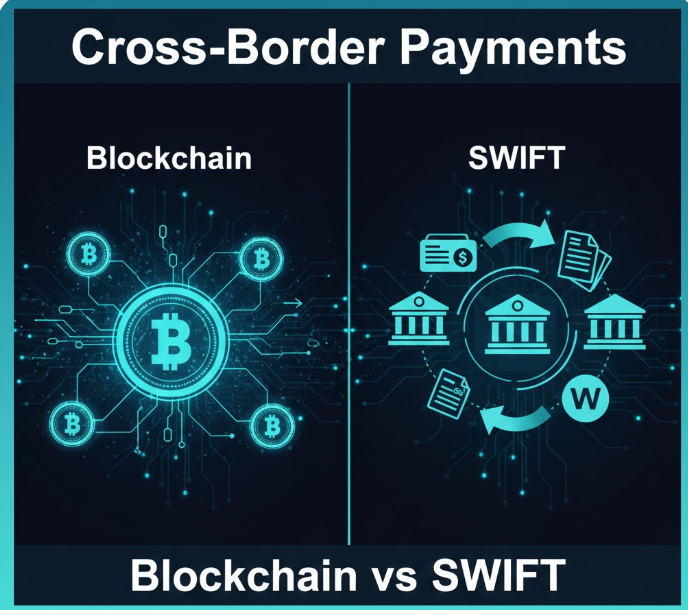
In today’s global economy, cross-border payments are essential for businesses, banks, and individuals. Traditionally, the SWIFT network has been the backbone of international money transfers. However, blockchain technology is rapidly emerging as an alternative, promising faster, cheaper, and more transparent transactions.
This guide compares blockchain-based cross-border payments and the SWIFT network, highlighting differences in speed, cost, security, and transparency, and helping enterprises and investors make informed decisions.
Understanding SWIFT: The Traditional System
The Society for Worldwide Interbank Financial Telecommunication (SWIFT) is a global messaging network that enables financial institutions to communicate securely for international transfers.
Key features:
-
Connects over 11,000 banks and institutions worldwide
-
Provides standardized messaging protocols
-
Facilitates settlements via correspondent banking relationships
How it works:
-
Bank A initiates a transfer through SWIFT.
-
SWIFT sends a message to Bank B via intermediary banks.
-
Funds are settled through correspondent accounts, often taking 2–5 business days.
Challenges of SWIFT
-
Slow transaction times: International transfers can take days, especially with intermediaries.
-
High fees: Each correspondent bank may charge fees, making transfers expensive.
-
Limited transparency: Tracking payments in real-time is difficult.
-
Vulnerability to errors: Manual reconciliation and messaging errors can cause delays.
While SWIFT is reliable and widely adopted, enterprises face inefficiencies when sending large volumes of cross-border payments.
Blockchain-Based Cross-Border Payments
Blockchain technology enables peer-to-peer transfers without intermediaries, using cryptographically secure ledgers to record transactions.
How it works:
-
Sender initiates a transfer on a blockchain network.
-
The network validates the transaction using consensus mechanisms.
-
Recipient receives funds almost instantly, often in minutes.
Popular blockchain platforms for cross-border payments include:
-
RippleNet (XRP)
-
Stellar (XLM)
-
Ethereum-based stablecoins (USDC, USDT)
Advantages of Blockchain Payments
-
Faster settlements: Transactions can settle within minutes.
-
Lower fees: Eliminates multiple intermediaries, reducing cost.
-
Transparency: Blockchain provides real-time visibility into the transaction.
-
Programmable payments: Smart contracts allow conditional payments and automated reconciliation.
Challenges of Blockchain Payments
-
Volatility: Cryptocurrencies can fluctuate in value, affecting transfers.
-
Regulatory compliance: AML/KYC laws apply and vary by country.
-
Adoption barriers: Not all banks or institutions accept blockchain transfers.
-
Network congestion: High transaction volumes can slow processing on some blockchains.
SWIFT vs Blockchain: Key Comparisons
| Feature | SWIFT | Blockchain |
|---|---|---|
| Speed | 2–5 business days | Minutes to hours |
| Cost | High, multiple fees | Lower, fewer intermediaries |
| Transparency | Limited | Full, real-time tracking |
| Settlement Finality | Depends on correspondent banks | Immediate once confirmed |
| Security | Strong, but human errors possible | Cryptographically secure, decentralized |
| Adoption | Nearly universal | Growing, not fully mainstream |
| Regulatory Oversight | Strong | Varies by jurisdiction |
When Blockchain Makes Sense
Blockchain is most suitable for:
-
Small and medium businesses sending frequent international payments
-
Cross-border payroll
-
Remittances to regions with limited banking infrastructure
-
Transactions requiring real-time settlement and transparency
When SWIFT Remains Relevant
SWIFT is ideal for:
-
Large enterprise transfers involving multiple currencies
-
Regulated banking transactions
-
Institutions requiring universal interoperability
-
Transfers in regions where blockchain adoption is limited
Hybrid Approaches
Many financial institutions are adopting hybrid models:
-
Using blockchain for speed and cost-efficiency
-
Leveraging SWIFT for regulatory compliance and reach
-
Combining blockchain with SWIFT APIs for reconciliation and audit purposes
This allows enterprises to optimize both speed and compliance.
Best Practices for Enterprises
-
Assess transaction volume and value – High-value payments may favor SWIFT for legal and compliance reasons.
-
Consider speed requirements – If speed is critical, blockchain offers clear advantages.
-
Evaluate regulatory landscape – Ensure compliance with AML, KYC, and reporting requirements.
-
Choose reputable providers – Use established blockchain networks or SWIFT-approved fintech solutions.
-
Plan for integration – Ensure ERP, accounting, and treasury systems can handle blockchain or SWIFT settlements.
Risks and Mitigation
Blockchain Risks
-
Crypto volatility: Use stablecoins or hedging mechanisms.
-
Regulatory uncertainty: Stay informed about local laws.
-
Technical errors: Use tested wallets and enterprise-grade infrastructure.
SWIFT Risks
-
Slow processing: Monitor payments actively.
-
High fees: Negotiate correspondent banking fees where possible.
-
Manual errors: Implement automated reconciliation tools.
FAQ
Can I replace SWIFT entirely with blockchain?
Not yet. While blockchain is faster and cheaper, SWIFT remains essential for regulatory compliance and universal access.
Are blockchain cross-border payments legal?
Yes, but compliance with AML/KYC and local regulations is mandatory.
Is blockchain faster than SWIFT for all countries?
Generally yes, but network congestion, liquidity, and local regulations can impact speed.
What currencies can I transfer via blockchain?
Most networks support cryptocurrencies or stablecoins; some platforms allow fiat tokenization.
How do enterprises reduce risk when using blockchain?
Use regulated exchanges, secure wallets, multi-signature setups, and monitor regulatory updates.
Conclusion
Both SWIFT and blockchain have advantages and limitations. Enterprises that need universal access and regulatory certainty often rely on SWIFT, while blockchain offers speed, transparency, and lower costs for operational payments.
Many modern strategies combine both approaches, allowing companies to leverage blockchain for efficiency while retaining SWIFT for compliance and reach.
For global enterprises and investors, understanding when and how to use each system is essential for effective treasury management and cross-border operations.