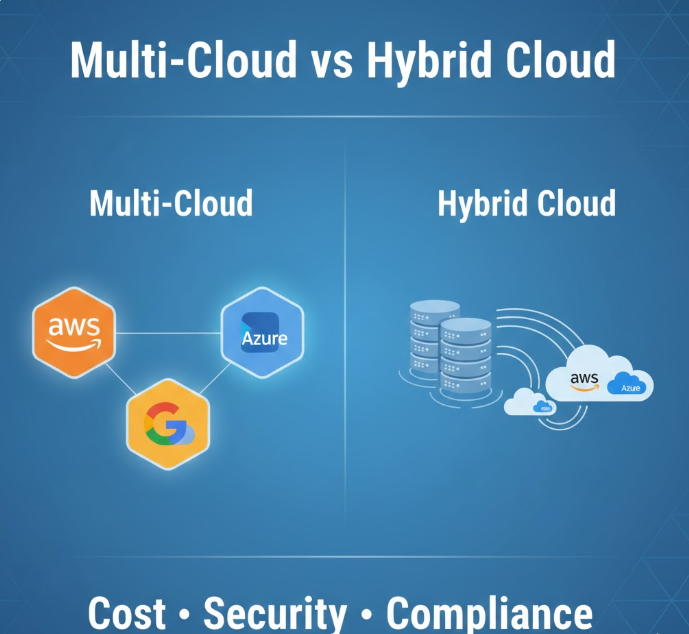
As organizations modernize their IT infrastructure, cloud adoption has moved beyond a single-provider strategy. Large enterprises, governments, and regulated industries increasingly rely on multi-cloud and hybrid cloud architectures to balance performance, cost, security, and compliance.
While these two models are often confused, they solve different business problems. Choosing the wrong approach can increase costs, introduce security gaps, and complicate compliance. This guide breaks down how multi-cloud and hybrid cloud differ, with a deep focus on cost, security, and regulatory compliance.
Understanding the Cloud Models
What Is Multi-Cloud?
A multi-cloud strategy uses two or more public cloud providers simultaneously.
For example:
-
Running workloads across AWS, Microsoft Azure, and Google Cloud
-
Choosing different providers for storage, compute, or AI services
In multi-cloud, all infrastructure is cloud-based, but no single vendor controls everything.
What Is Hybrid Cloud?
A hybrid cloud combines:
-
On-premises infrastructure (data centers or private cloud)
-
Public cloud services
These environments are integrated and managed together, allowing data and workloads to move between private and public infrastructure.
Core Differences at a Glance
| Aspect | Multi-Cloud | Hybrid Cloud |
|---|---|---|
| Infrastructure | Multiple public clouds | On-prem + public cloud |
| Primary Goal | Avoid vendor lock-in | Control + flexibility |
| Complexity | High | High |
| Compliance Strength | Medium–High | Very High |
| Cost Predictability | Variable | More predictable |
| Security Control | Shared | Strong internal control |
Cost Comparison: Multi-Cloud vs Hybrid Cloud
Multi-Cloud Cost Structure
Advantages
-
Competitive pricing across providers
-
Ability to choose cost-efficient services
-
Reduced vendor dependency
Challenges
-
Complex billing models
-
Difficult cost allocation
-
Higher operational overhead
-
Data transfer costs between clouds
Hidden costs often include:
-
Network egress fees
-
Duplicate tooling
-
Specialized staff for each cloud
Multi-cloud costs can grow quickly without strong financial governance.
Hybrid Cloud Cost Structure
Advantages
-
Existing infrastructure continues to deliver value
-
Sensitive workloads stay on-prem
-
Predictable capital and operational expenses
-
Better control over long-term costs
Challenges
-
Upfront infrastructure investments
-
Maintenance and upgrade costs
-
Need for skilled internal IT teams
Hybrid cloud works best when:
-
Legacy systems are expensive to migrate
-
Data locality reduces cloud usage costs
Cost Verdict
-
Multi-cloud is cost-efficient when optimized, but volatile without governance
-
Hybrid cloud offers better long-term cost predictability for large enterprises
Security Comparison
Multi-Cloud Security
Security in multi-cloud environments is shared across providers, each with different:
-
Identity systems
-
Encryption standards
-
Logging and monitoring tools
Security strengths
-
Reduced single-provider risk
-
Geographic redundancy
-
Strong native cloud security tools
Security risks
-
Inconsistent security policies
-
Complex identity and access management
-
Increased attack surface
-
Tool fragmentation
Security failures often result from misconfiguration, not provider weaknesses.
Hybrid Cloud Security
Hybrid cloud provides maximum control over sensitive data.
Security strengths
-
On-prem control over critical workloads
-
Custom encryption and access policies
-
Strong segmentation of sensitive systems
-
Reduced exposure to public networks
Security challenges
-
Requires mature internal security teams
-
Complex integration between environments
-
Responsibility for patching and updates
Hybrid cloud is preferred where data sovereignty and confidentiality are critical.
Security Verdict
-
Multi-cloud offers resilience but increases complexity
-
Hybrid cloud delivers stronger security control and customization
Compliance Comparison
Multi-Cloud Compliance
Multi-cloud environments must align compliance across:
-
Multiple providers
-
Multiple regions
-
Multiple regulatory frameworks
Compliance challenges
-
Data residency rules differ by provider
-
Auditing across platforms is complex
-
Consistent policy enforcement is difficult
Multi-cloud is suitable when:
-
Compliance frameworks are flexible
-
Workloads are not highly regulated
Hybrid Cloud Compliance
Hybrid cloud excels in regulated industries:
-
Finance
-
Healthcare
-
Government
-
Energy
Compliance strengths
-
Sensitive data remains on-prem
-
Easier audits and documentation
-
Strong control over data location
-
Better alignment with strict regulations
Hybrid cloud simplifies compliance by keeping regulated workloads under direct organizational control.
Compliance Verdict
-
Multi-cloud meets compliance with effort and tooling
-
Hybrid cloud is superior for strict regulatory requirements
Operational Complexity
Multi-Cloud Complexity
-
Multiple APIs
-
Multiple monitoring tools
-
Multiple security models
-
Requires cross-cloud expertise
Without automation, operational costs increase significantly.
Hybrid Cloud Complexity
-
Integration between environments
-
Network synchronization
-
Consistent identity management
Hybrid cloud complexity is architectural, but more centralized.
When to Choose Multi-Cloud
Multi-cloud is ideal when:
-
Vendor lock-in is a major concern
-
High availability across regions is critical
-
Teams can manage complexity
-
Innovation and service diversity are priorities
When to Choose Hybrid Cloud
Hybrid cloud is ideal when:
-
Data sovereignty is mandatory
-
Legacy systems must be retained
-
Compliance requirements are strict
-
Long-term cost control matters
Multi-Cloud and Hybrid Cloud in Practice
Many large enterprises now adopt hybrid multi-cloud strategies:
-
Sensitive workloads on-prem
-
Public workloads spread across multiple clouds
-
Centralized governance and security controls
This approach combines the strengths of both models—but also requires maturity.
Common Mistakes to Avoid
-
Choosing based on trends instead of business needs
-
Ignoring long-term operational costs
-
Underestimating security complexity
-
Delaying governance planning
-
Treating compliance as an afterthought
FAQ
Is multi-cloud more expensive than hybrid cloud?
It can be, especially without strong cost governance and visibility.
Which model is more secure?
Hybrid cloud offers stronger control, while multi-cloud offers resilience.
Can small businesses use hybrid cloud?
Hybrid cloud is typically better suited for mid-to-large organizations.
Do compliance regulations favor one model?
Highly regulated industries usually prefer hybrid cloud.
Can organizations switch later?
Yes, but migration costs and complexity should be planned carefully.
Conclusion
There is no universal “best” cloud strategy. Multi-cloud and hybrid cloud serve different purposes, and the right choice depends on cost sensitivity, security posture, and compliance obligations.
-
Multi-cloud prioritizes flexibility and vendor independence
-
Hybrid cloud prioritizes control, compliance, and predictability
Successful organizations align their cloud strategy with business objectives, not hype.