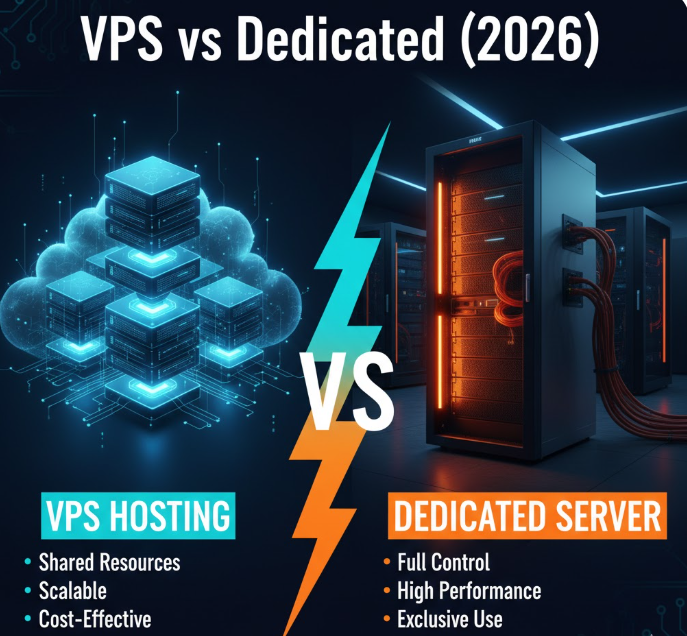
Choosing the right hosting infrastructure is one of the most important technical decisions for any website, application, or online business. In 2026, with cloud platforms, virtualization, and global traffic demands more advanced than ever, the choice between VPS hosting and a dedicated server is no longer just about price—it’s about performance, scalability, security, control, and long-term growth.
This guide explains how VPS hosting and dedicated servers actually work, where each option excels, where they fall short, and how to decide which one fits your real needs—not marketing claims.
What Is VPS Hosting?
VPS (Virtual Private Server) hosting is a hosting model where a single physical server is divided into multiple virtual servers using virtualization technology.
Each VPS:
-
Has its own operating system
-
Has allocated CPU, RAM, and storage
-
Operates independently from other VPS instances on the same machine
From the user’s perspective, a VPS behaves much like a dedicated server, but under the hood, resources are still shared at the physical level.
How VPS Hosting Works Behind the Scenes
A powerful physical server runs a hypervisor (such as KVM, VMware, or Hyper-V). This hypervisor:
-
Splits hardware resources into isolated virtual environments
-
Assigns guaranteed portions of CPU, memory, and disk
-
Prevents direct interference between VPS instances
Modern VPS platforms in 2026 benefit from:
-
Faster NVMe storage
-
Improved CPU scheduling
-
Better isolation than older shared hosting
-
Automated scaling options
What Is a Dedicated Server?
A dedicated server is a physical machine rented or owned by a single customer.
You get:
-
100% of the CPU
-
100% of the RAM
-
100% of the storage
-
Full control over hardware and software configuration
No other users share the server—everything is exclusively yours.
How Dedicated Servers Work in Practice
With a dedicated server:
-
The operating system runs directly on the hardware
-
There is no hypervisor overhead
-
Hardware resources are fixed unless physically upgraded
-
Performance is consistent and predictable
Dedicated servers are often hosted in professional data centers with:
-
Redundant power supplies
-
High-speed network connections
-
Physical security and monitoring
Performance Comparison (2026 Reality)
VPS Performance
In 2026, VPS hosting has improved significantly:
-
High-end VPS plans offer excellent performance
-
NVMe storage reduces I/O bottlenecks
-
CPU isolation is stronger than in previous years
However:
-
Performance can still fluctuate under extreme load
-
CPU burst limits may apply
-
Physical hardware is shared behind the scenes
Dedicated Server Performance
Dedicated servers offer:
-
Maximum and consistent performance
-
No competition for CPU cycles
-
Better handling of sustained heavy workloads
For high-traffic or resource-intensive applications, dedicated servers still lead.
Verdict: Dedicated servers win for raw, predictable performance. VPS is more than enough for most modern workloads.
Scalability and Flexibility
VPS Scalability
One of the biggest advantages of VPS hosting is easy scaling:
-
Upgrade RAM or CPU in minutes
-
Resize storage without downtime (on many platforms)
-
Suitable for growing projects
This flexibility is ideal for:
-
Startups
-
SaaS platforms
-
Content sites with variable traffic
Dedicated Server Scalability
Dedicated servers are harder to scale:
-
Hardware upgrades require downtime
-
Adding resources may involve server replacement
-
Scaling often means adding more servers
Dedicated servers are better for stable, predictable workloads.
Cost Comparison
VPS Hosting Costs
-
Generally much cheaper
-
Pay only for what you need
-
Monthly pricing is predictable
-
No hardware maintenance costs
In 2026, VPS hosting offers excellent value for small to mid-sized projects.
Dedicated Server Costs
-
Higher monthly fees
-
Often includes setup fees
-
Higher management and maintenance costs
-
Best value when fully utilized
Verdict: VPS hosting is more cost-efficient for most users. Dedicated servers make sense when performance demands justify the price.
Security Considerations
VPS Security
-
Strong isolation between virtual machines
-
Depends heavily on hypervisor security
-
Shared hardware still presents a theoretical risk
-
Most attacks target software, not virtualization layers
VPS security is generally sufficient for:
-
Business websites
-
Web apps
-
Databases
-
Content platforms
Dedicated Server Security
-
Complete isolation at the hardware level
-
Lower attack surface from other tenants
-
Greater control over firewall and system hardening
Dedicated servers are often preferred for:
-
Financial systems
-
Sensitive data processing
-
Compliance-driven environments
Control and Customization
VPS Control
-
Full root or admin access
-
OS choice limited by provider
-
Some kernel-level restrictions may apply
Dedicated Server Control
-
Full hardware and OS control
-
Custom kernels, RAID setups, and BIOS access
-
Ability to fine-tune performance at the lowest level
If deep customization is critical, dedicated servers provide unmatched control.
Reliability and Uptime
VPS Reliability
-
Dependent on the host node’s health
-
Good providers offer failover and backups
-
A hardware failure may affect multiple VPS instances
Dedicated Server Reliability
-
Single point of failure per server
-
Often paired with redundancy strategies
-
Greater transparency over hardware health
In 2026, both options can achieve excellent uptime when hosted by reputable providers.
Management and Maintenance
VPS Management
-
Easier to manage
-
Many providers offer managed VPS plans
-
Ideal for teams without deep sysadmin expertise
Dedicated Server Management
-
Requires more technical knowledge
-
Managed options exist but cost more
-
Best suited for experienced teams
Use-Case Comparison
Choose VPS Hosting If You:
-
Run a blog, business website, or e-commerce store
-
Operate a growing SaaS or startup
-
Need scalability and cost efficiency
-
Want easier server management
Choose a Dedicated Server If You:
-
Run high-traffic platforms
-
Host large databases or game servers
-
Require strict compliance or data isolation
-
Need maximum performance and control
VPS vs Dedicated Server in 2026: The Big Picture
The gap between VPS hosting and dedicated servers has narrowed significantly due to:
-
Faster virtualization
-
Better resource isolation
-
Improved cloud infrastructure
For most users in 2026:
-
High-quality VPS hosting is sufficient
-
Dedicated servers remain essential for specialized workloads
Frequently Asked Questions (FAQ)
Is VPS hosting secure enough in 2026?
Yes. For most applications, VPS hosting provides strong security when properly configured.
Does a VPS perform like a dedicated server?
For moderate workloads, yes. Under extreme load, dedicated servers still perform better.
Can I upgrade from VPS to dedicated later?
Yes. Many providers support smooth migration as your needs grow.
Are dedicated servers becoming obsolete?
No. They remain critical for performance-sensitive and compliance-driven workloads.
Final Recommendation
In 2026, the decision between VPS hosting and a dedicated server should be driven by actual requirements, not assumptions.
-
Choose VPS hosting for flexibility, cost efficiency, and scalability.
-
Choose a dedicated server when performance, isolation, and control are non-negotiable.
For most modern projects, starting with a VPS and upgrading later is the smartest path.