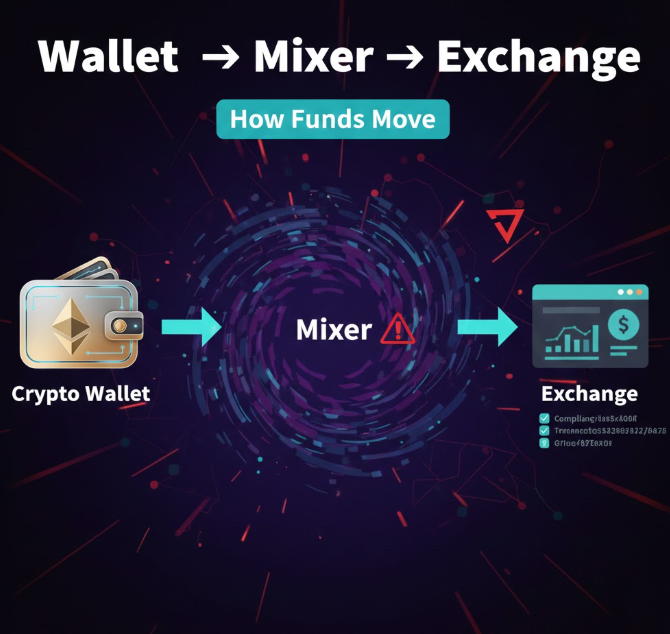
Cryptocurrency transactions are public, traceable, and permanent—yet many people still assume crypto is anonymous. In reality, the way funds move from a wallet, through a privacy tool (often called a mixer), and eventually to an exchange is governed by transparent blockchain mechanics, platform policies, and regulatory controls.
This article explains—at a conceptual level—how funds move across these stages, what each component does, and how compliance and monitoring shape outcomes. The goal is understanding, not instruction.
1) The Starting Point: Crypto Wallets
A crypto wallet is software or hardware that manages cryptographic keys. These keys authorize transactions on a blockchain. Wallets do not “hold” coins in the traditional sense; balances are recorded on the blockchain, and wallets provide the ability to spend them.
Types of Wallets
-
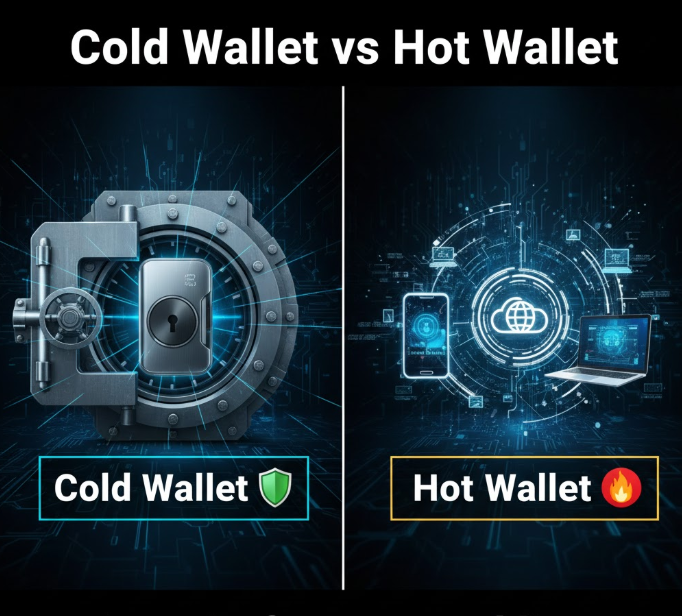
Self-custody wallets: The user controls the private keys (e.g., mobile, desktop, hardware wallets).
-
Custodial wallets: A service (often an exchange) controls keys on the user’s behalf.
What Happens When Funds Move
When a user initiates a transfer:
-
The wallet creates a transaction referencing previous outputs (UTXOs on Bitcoin-like chains) or balances (account-based chains).
-
The transaction is signed with the private key.
-
It is broadcast to the network.
-
Validators/miners include it in a block.
From the very first hop, addresses, amounts, timestamps, and transaction hashes are public.
2) The Transparency Layer: On-Chain Traceability
Contrary to popular belief, most blockchains are pseudonymous, not anonymous.
What Is Visible On-Chain
-
Sending and receiving addresses
-
Amounts transferred
-
Time and block number
-
Transaction relationships (inputs/outputs)
Over time, patterns emerge. Analysts can cluster addresses that appear controlled by the same entity and track flows across hops. This is why blockchain analysis is widely used by exchanges, auditors, and regulators.
3) Privacy Tools (Often Called “Mixers”): What They Are Conceptually
Privacy tools aim to reduce the direct link between sending and receiving addresses. Historically, these tools pooled transactions or used cryptographic techniques to make transaction flows less obvious.
It’s important to distinguish purpose from use:
-
Purpose: Enhance financial privacy in a public ledger.
-
Use: Can be legitimate (privacy protection) or problematic (obscuring illicit proceeds).
High-Level Mechanisms (Conceptual)
Without operational detail, privacy tools may:
-
Aggregate many users’ funds
-
Introduce delays or batching
-
Use cryptographic proofs to obscure direct links
The blockchain still records transactions—but the direct, linear trail becomes harder to follow.
4) What Changes When Funds Pass Through Privacy Tools
Traceability Is Reduced, Not Eliminated
-
The ledger remains public.
-
Analysts rely on probabilistic methods rather than direct links.
-
Patterns (timing, amounts, re-entry points) can still be analyzed.
Risk Flags Increase
Many regulated platforms treat interactions with privacy tools as higher risk, regardless of intent. This doesn’t imply wrongdoing; it reflects compliance obligations.
5) The Exchange Entry Point: Where Rules Tighten
Centralized exchanges (CEXs) are the most regulated gateways in crypto. When funds arrive at an exchange deposit address, multiple checks occur.
What Exchanges See
-
The incoming transaction hash
-
The source address and its history
-
The asset type and amount
What Exchanges Do
-
Screen deposits using blockchain analytics
-
Compare addresses against risk databases
-
Apply internal policies and legal requirements
If a deposit is associated with high-risk activity, the exchange may:
-
Delay crediting the funds
-
Request additional information
-
Restrict withdrawals
-
In rare cases, freeze assets pending review
This is not arbitrary; exchanges must comply with AML/KYC regulations in their jurisdictions.
6) Why Funds Can Be Flagged After Reaching an Exchange
Flags are usually based on association, not certainty.
Common triggers include:
-
Direct or indirect links to known incidents (hacks, scams)
-
Interaction with sanctioned addresses
-
Exposure to high-risk services
-
Unusual transaction patterns
Even legitimate users can be affected if their funds share proximity with flagged activity. This is a known challenge in compliance.
7) Can Funds Still “Move” After Being Flagged?
On the Blockchain
-
The blockchain itself does not stop transactions.
-
Native assets can still be transferred between addresses.
On Platforms
-
Exchanges may block or restrict actions.
-
Some token issuers can freeze specific assets at the contract level.
-
DeFi frontends may deny access while the protocol remains accessible at the contract layer.
This distinction—protocol vs. platform—is crucial to understanding real-world outcomes.
8) The Role of Blockchain Analytics (Behind the Scenes)
Analytics firms analyze:
-
Transaction graphs
-
Address clustering
-
Behavioral patterns
-
Cross-chain bridges and hops
They do not “control” funds. Instead, they provide risk assessments that platforms use to make decisions. The assessments are probabilistic and continually updated as new data appears.
9) Privacy vs. Compliance: A Real Tension
Crypto’s design emphasizes transparency, while users value privacy. Exchanges and regulators emphasize compliance. The result is a balancing act:
-
Privacy tools seek to reduce public linkage.
-
Compliance systems seek to assess and manage risk.
-
Users navigate both worlds, often unknowingly.
This tension is why outcomes vary widely depending on jurisdiction, asset type, and platform policy.
10) Common Misconceptions
“Mixers make funds untraceable.”
Not entirely. They complicate analysis but don’t erase history.
“Exchanges instantly confiscate funds.”
Usually false. Most cases involve reviews, requests for information, or restrictions—not immediate loss.
“Only illegal users are affected.”
Incorrect. Association-based risk can affect legitimate users.
11) Practical, Non-Operational Awareness Tips (Safety-Focused)
Without providing instructions, it’s helpful to understand:
-
Your transaction history matters.
-
Platform rules differ by region.
-
Documentation and transparency help during reviews.
-
Separation of activities (conceptually) can reduce confusion.
These are awareness principles, not operational guidance.
12) How Regulations Shape the Flow
Regulatory frameworks influence how funds move at the exchange boundary:
-
AML laws require monitoring and reporting
-
Sanctions regimes restrict interactions with certain entities
-
Travel Rule implementations increase data sharing
As regulations evolve, exchanges adjust policies, which directly affects user experience.
13) What This Means for the Average User
For most users:
-
Day-to-day transactions proceed normally
-
Issues arise primarily at regulated gateways
-
Understanding the ecosystem reduces surprises
Crypto is open by design, but participation in centralized services comes with rules.
Frequently Asked Questions (FAQ)
Is using privacy tools illegal?
Legality varies by jurisdiction and context. Many uses are lawful, but platforms may still apply restrictions.
Can exchanges see my identity from the blockchain?
Blockchains show addresses, not names. Identity linkage occurs through platform accounts and compliance processes.
Do all assets behave the same way?
No. Native coins, tokens, and stablecoins have different controls and issuer policies.
Can funds be permanently lost?
Permanent loss is uncommon. Most issues involve delays, reviews, or restricted access.
Final Thoughts
The journey from wallet to privacy tool to exchange is shaped by transparent blockchains, probabilistic analysis, and regulatory obligations. Funds don’t vanish, and blockchains don’t secretly change—but access and usability can change dramatically at regulated checkpoints.
Understanding these mechanics helps users make informed decisions and reduces confusion when platform reviews occur. Crypto remains open at the protocol level, while the services built on top operate within legal and compliance frameworks.