Blockchain technology has evolved far beyond cryptocurrency. By 2026, it has become a foundational layer for Web3, decentralized finance, digital identity, supply chain transparency, gaming, healthcare, and even government systems.
This ultimate guide explains blockchain technology from the ground up, covering how it works, its architecture, security mechanisms, Web3 integration, and real-world use cases—written clearly for beginners, developers, and business readers alike.
What Is Blockchain Technology?
Blockchain is a distributed digital ledger that records transactions across a network of computers in a way that is:
-
Decentralized
-
Transparent
-
Tamper-resistant
-
Verifiable
Instead of relying on a single central authority, blockchain uses network consensus to validate and store data.
Simple Definition
A blockchain is a chain of blocks, where each block contains:
-
Transaction data
-
A timestamp
-
A cryptographic hash of the previous block
This structure makes the data extremely difficult to alter.

Why Blockchain Matters in 2026
By 2026, trust in digital systems is more important than ever. Blockchain solves problems that traditional systems struggle with:
-
Single points of failure
-
Data manipulation
-
Lack of transparency
-
Over-reliance on intermediaries
Blockchain enables trust without requiring trust in a central authority.
Core Principles of Blockchain Technology
1. Decentralization
Data is distributed across many nodes instead of stored on a central server.
2. Transparency
Transactions are publicly verifiable on most blockchains.
3. Immutability
Once data is recorded, it cannot be changed without network consensus.
4. Security
Cryptography ensures data integrity and user authentication.
Blockchain Architecture Explained
Understanding blockchain architecture helps explain why it is so secure and reliable.
1. Blocks
Each block typically contains:
-
Transaction list
-
Block number
-
Timestamp
-
Previous block hash
-
Current block hash
Altering one block changes its hash, breaking the chain.
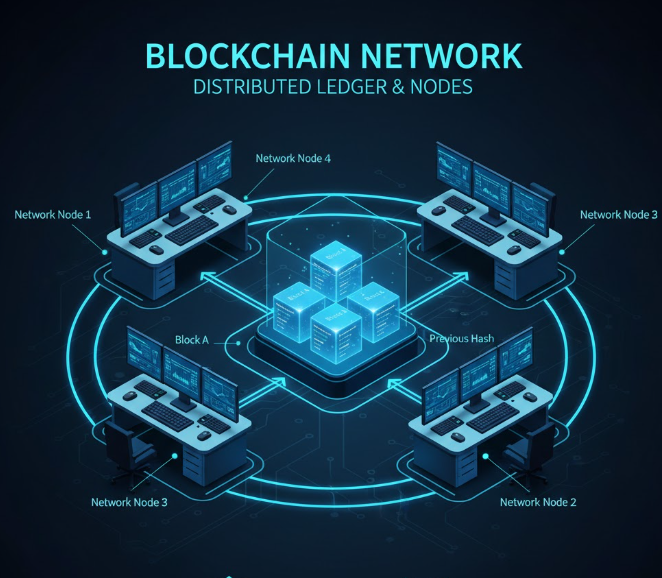
2. Nodes
Nodes are computers that:
-
Store a copy of the blockchain
-
Validate transactions
-
Enforce network rules
Types of nodes:
-
Full nodes
-
Light nodes
-
Validator nodes
3. Consensus Mechanisms
Consensus determines how the network agrees on valid transactions.
Common Consensus Models (2026)
Proof of Work (PoW)
-
Used by Bitcoin
-
High security
-
Energy intensive
Proof of Stake (PoS)
-
Used by Ethereum
-
Energy efficient
-
Validators stake tokens
Delegated Proof of Stake (DPoS)
-
Faster transactions
-
Elected validators
Proof of Authority (PoA)
-
Used in enterprise and private blockchains
Blockchain Security: How Data Is Protected
Security is one of blockchain’s strongest features.
1. Cryptographic Hashing
Each block uses a cryptographic hash function:
-
Converts data into a fixed-length string
-
Any small change creates a completely different hash
This ensures tamper detection.
2. Public and Private Keys
Blockchain uses asymmetric cryptography:
-
Public key: wallet address
-
Private key: access control
Only the private key owner can authorize transactions.

3. Decentralized Validation
No single entity controls the ledger.
To attack the network, a malicious actor would need control over most of the network—an extremely difficult task.
What Is Web3?
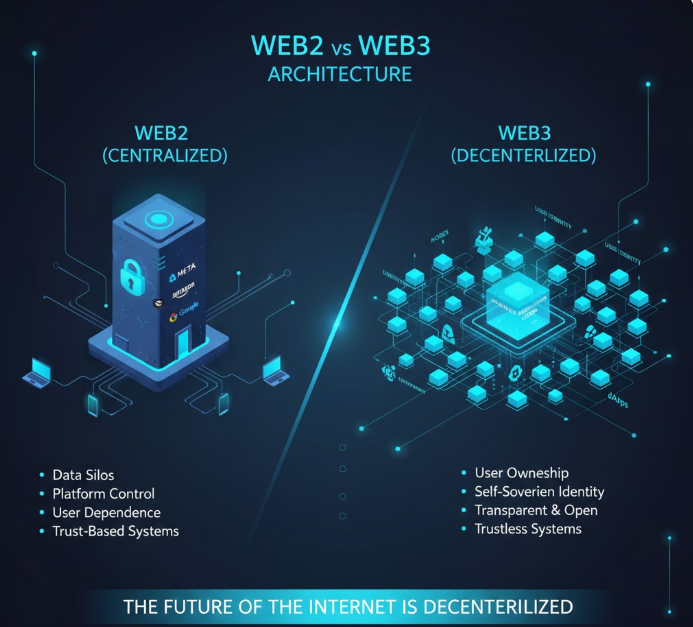
Web3 is the next generation of the internet, built on blockchain technology.
Comparison of Web Generations
| Web Version | Key Feature |
|---|---|
| Web1 | Read-only websites |
| Web2 | User-generated content (social media) |
| Web3 | User-owned data and assets |
Web3 shifts control from corporations to users.
How Blockchain Powers Web3
Blockchain enables Web3 through:
-
Smart contracts
-
Decentralized applications (dApps)
-
Tokenized economies
-
Self-sovereign identity
Smart Contracts Explained
Smart contracts are self-executing programs stored on the blockchain.
They automatically execute actions when conditions are met.
Key Benefits
-
No intermediaries
-
Transparent logic
-
Reduced fraud
-
Faster execution
Example Use Cases
-
Automated payments
-
NFT minting
-
Decentralized lending
-
Supply chain verification
Real-World Use Cases of Blockchain in 2026
Blockchain is no longer theoretical—it is actively used across industries.
1. Cryptocurrency and Digital Payments
-
Borderless transactions
-
Lower fees
-
Financial inclusion
Used for:
-
Remittances
-
Online payments
-
Store of value
2. Decentralized Finance (DeFi)
DeFi replaces traditional financial services with smart contracts.
DeFi Applications
-
Lending and borrowing
-
Decentralized exchanges
-
Yield farming
-
Stablecoins

3. Supply Chain Management
Blockchain improves supply chains by providing:
-
Product traceability
-
Fraud prevention
-
Real-time verification
Used in:
-
Food safety
-
Pharmaceuticals
-
Luxury goods
4. Healthcare and Medical Records
Blockchain enables:
-
Secure patient data sharing
-
Tamper-proof medical records
-
Interoperability between hospitals
Patients gain control over their data.
5. Digital Identity
Blockchain-based identity systems allow:
-
Self-sovereign identity
-
Reduced identity theft
-
Secure verification without data exposure
This is especially useful for:
-
Refugees
-
Cross-border services
-
Online authentication
6. Gaming and the Metaverse
Blockchain gaming allows:
-
True asset ownership
-
NFT-based items
-
Player-driven economies
Gamers can trade, sell, and own in-game assets outside the game.
Public vs Private vs Consortium Blockchains
Public Blockchains
-
Open to anyone
-
Fully decentralized
-
Example: Bitcoin, Ethereum
Private Blockchains
-
Controlled by one organization
-
Used by enterprises
Consortium Blockchains
-
Controlled by a group of organizations
-
Used in banking and logistics
Challenges Facing Blockchain in 2026
Despite growth, blockchain still faces challenges:
-
Scalability
-
Regulatory uncertainty
-
User experience complexity
-
Interoperability between chains
Layer-2 solutions and cross-chain protocols are actively addressing these issues.
The Future of Blockchain Beyond 2026
Expected trends include:
-
Increased enterprise adoption
-
Integration with AI and IoT
-
More user-friendly wallets
-
Stronger privacy solutions
-
Global digital identity frameworks
Blockchain is moving from speculation to infrastructure.
Final Thoughts
Blockchain technology in 2026 is no longer just about cryptocurrency. It is a core digital infrastructure powering Web3, decentralization, secure data sharing, and trustless systems across industries.
Understanding blockchain today is not optional—it is essential for anyone interested in technology, finance, business, or the future of the internet.
Leave a Reply